Validated systematic synthetic phonics programmes
The Magic alpha-belt is not a validated SSP programme; however, we have ensured that we have designed our content, resources, and activities to closely mirror and complement the teaching of phonics in primary schools.
Before programmes can be adopted in schools, the DfE sets out 16 core criteria that must be met before a phonics programme can achieve validated status.
We have set out below how we believe the Magic Alpha-Belt complements 14 of the 16 criteria tests, which are framed by the DfE as a series of questions.
.
Is it a complete, validated systematic synthetic phonics (SSP) programme?
The Magic alpha–belt is not a DfE-validated phonics programme, but our resources meet 13 of the 16 validation criteria. We offer a fresh, multi-sensory approach that complements validated SSP programmes used in primary schools, providing teachers and pupils with greater variety and choice.
Does it present systematic synthetic phonics as the prime approach to decoding print?
Yes. Our programme follows a systematic synthetic phonics (SSP) approach, teaching children to decode by matching sounds (phonemes) to letters (graphemes) and blending them to read.
“Systematic” refers to a clear, progressive sequence of teaching, while “synthetic” means blending individual sounds to form words.
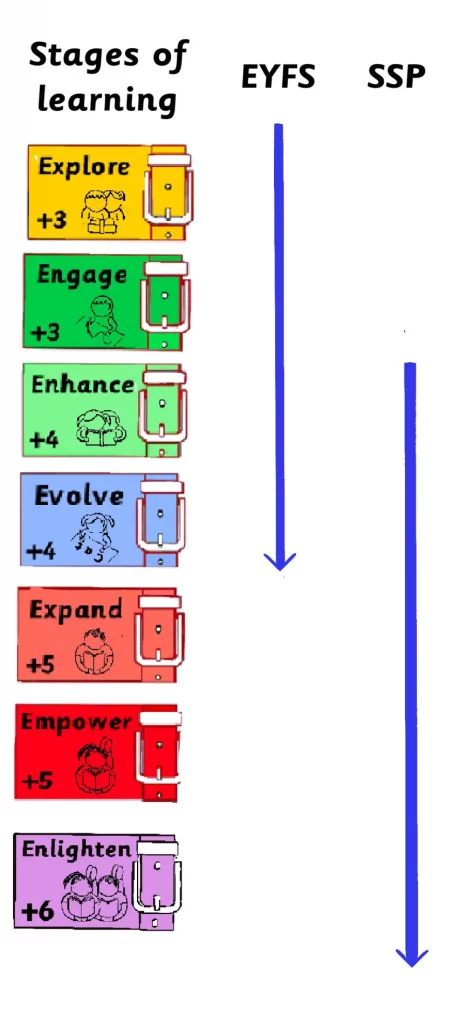
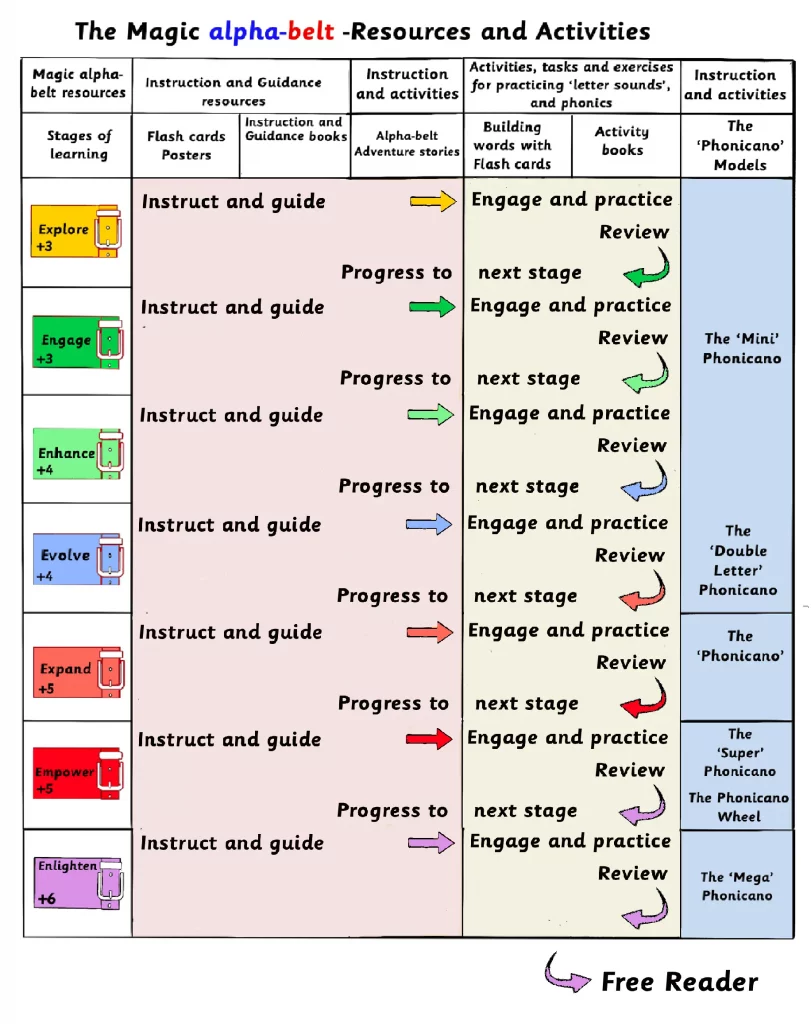
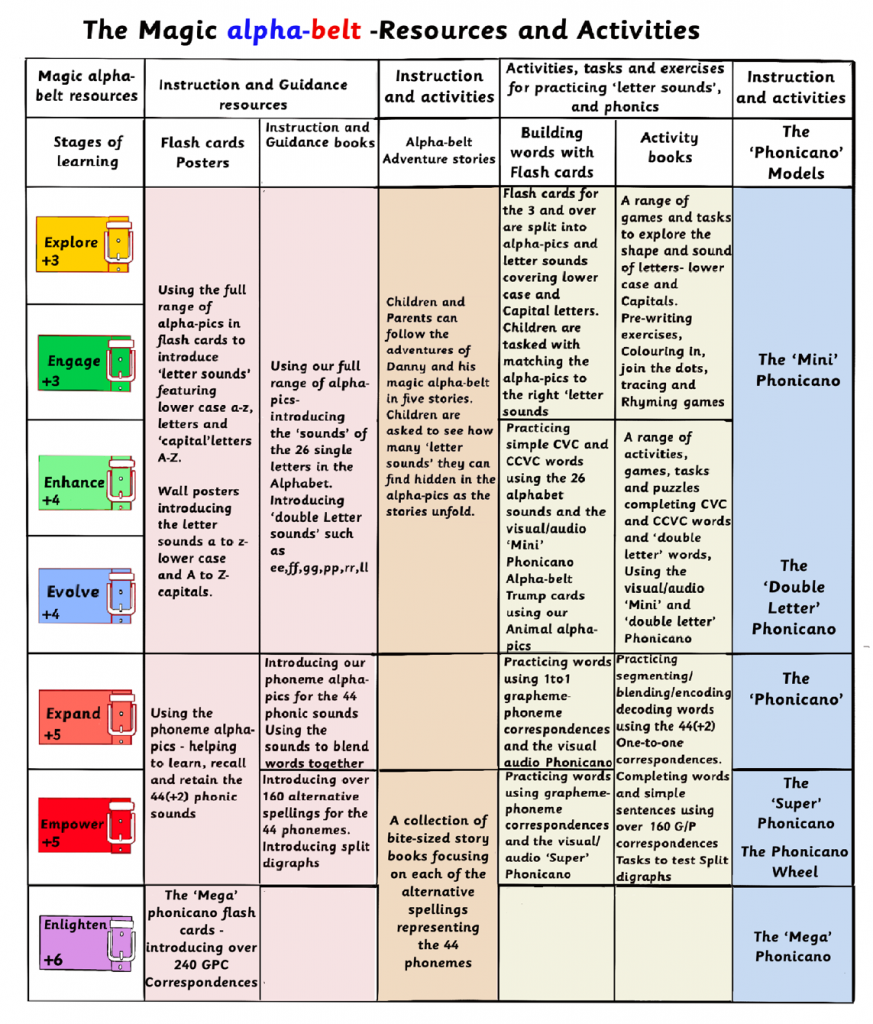
We introduce phonics through seven structured stages (the 7E stages):
Explore and Engage (3+): Introduces letter shapes and sounds in preparation for formal phonics. Enhance and Evolve (4+): Teaches the 26 alphabet sounds. Expanding (5+): Covers the 44 phonemes. Empowering: Introduces 170+ common grapheme-phoneme correspondences (GPCs).Enlightening (6+): Presents over 240 GPCs through our Phonics Through Stories series—supporting the transition from decodable books to free readers.
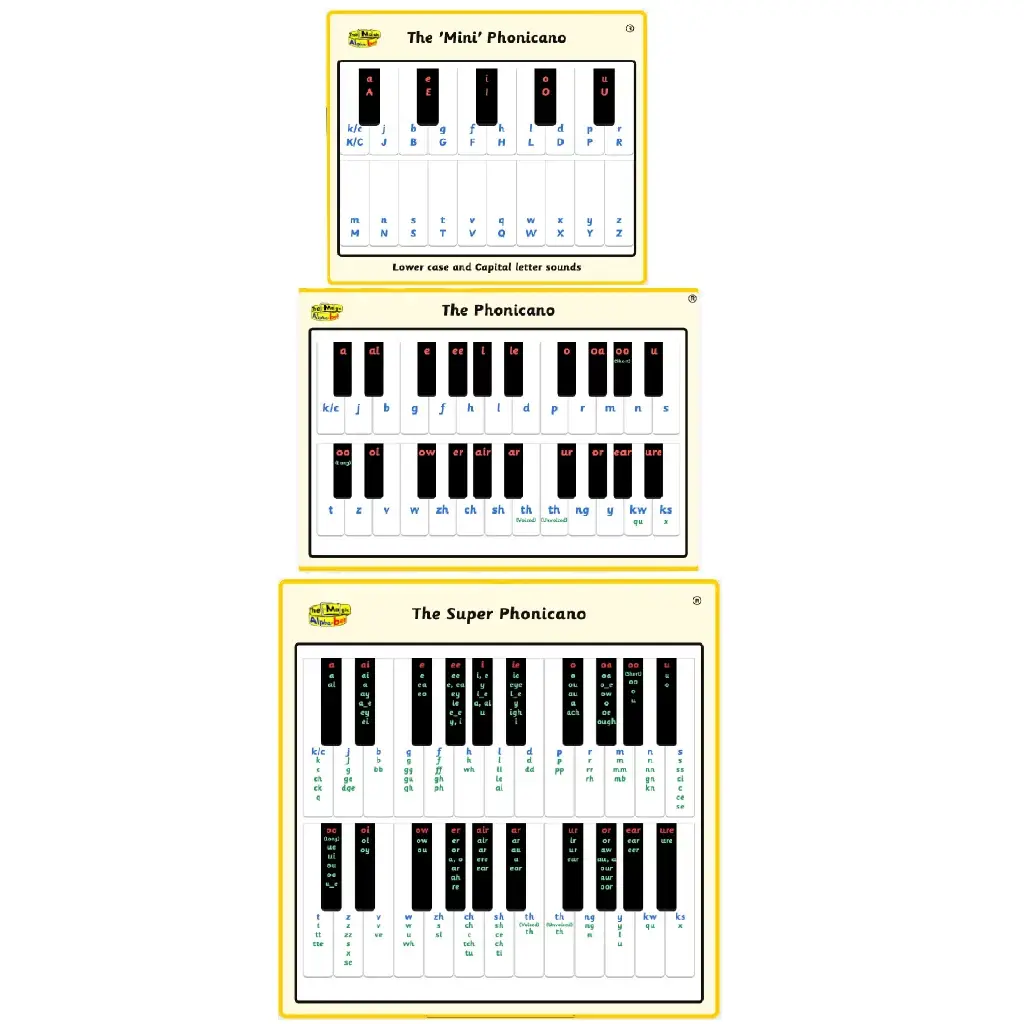
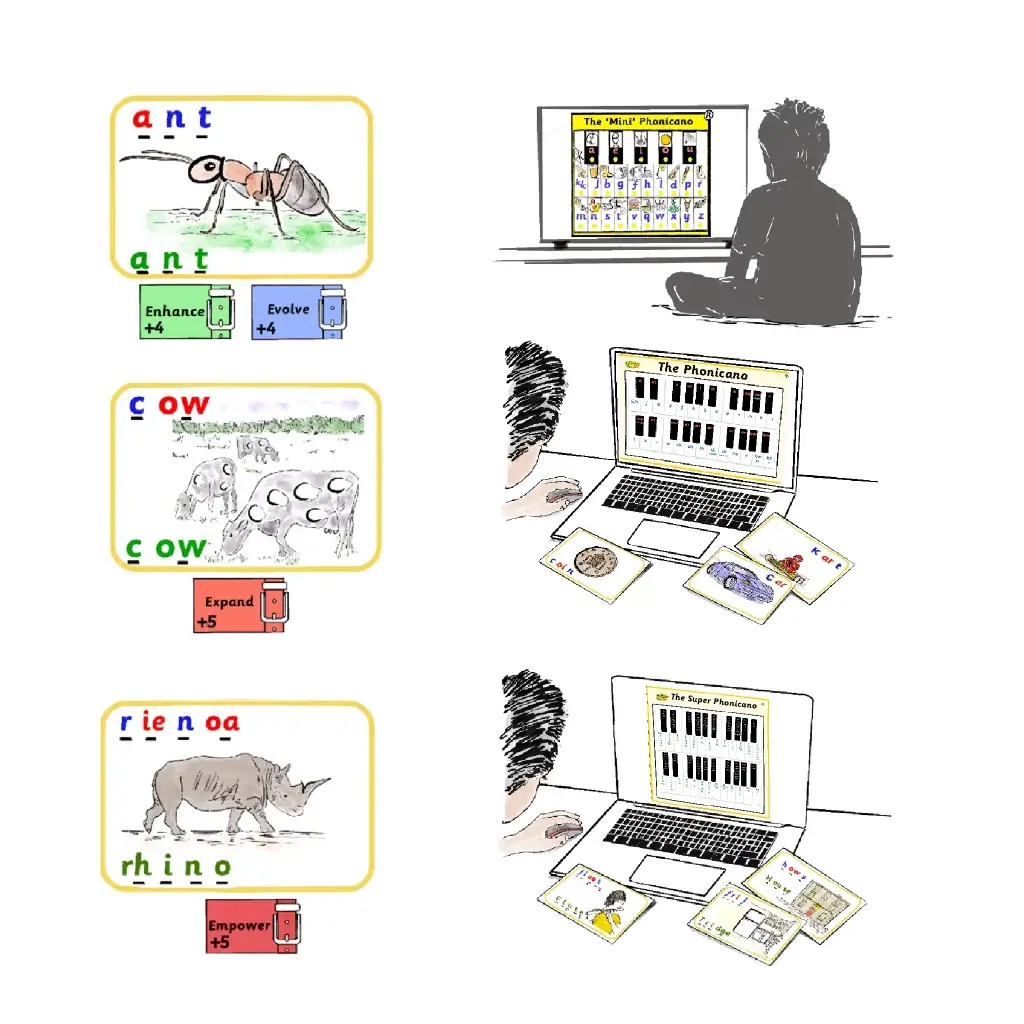
Our Phonicano tools (visual and audio aids) help children build words through play. These include:
Mini Phonicano: Covers the 26 single-letter sounds.
Phonicano: Covers the 44 one- to- one grapheme-phoneme correspondences (GPC’s).
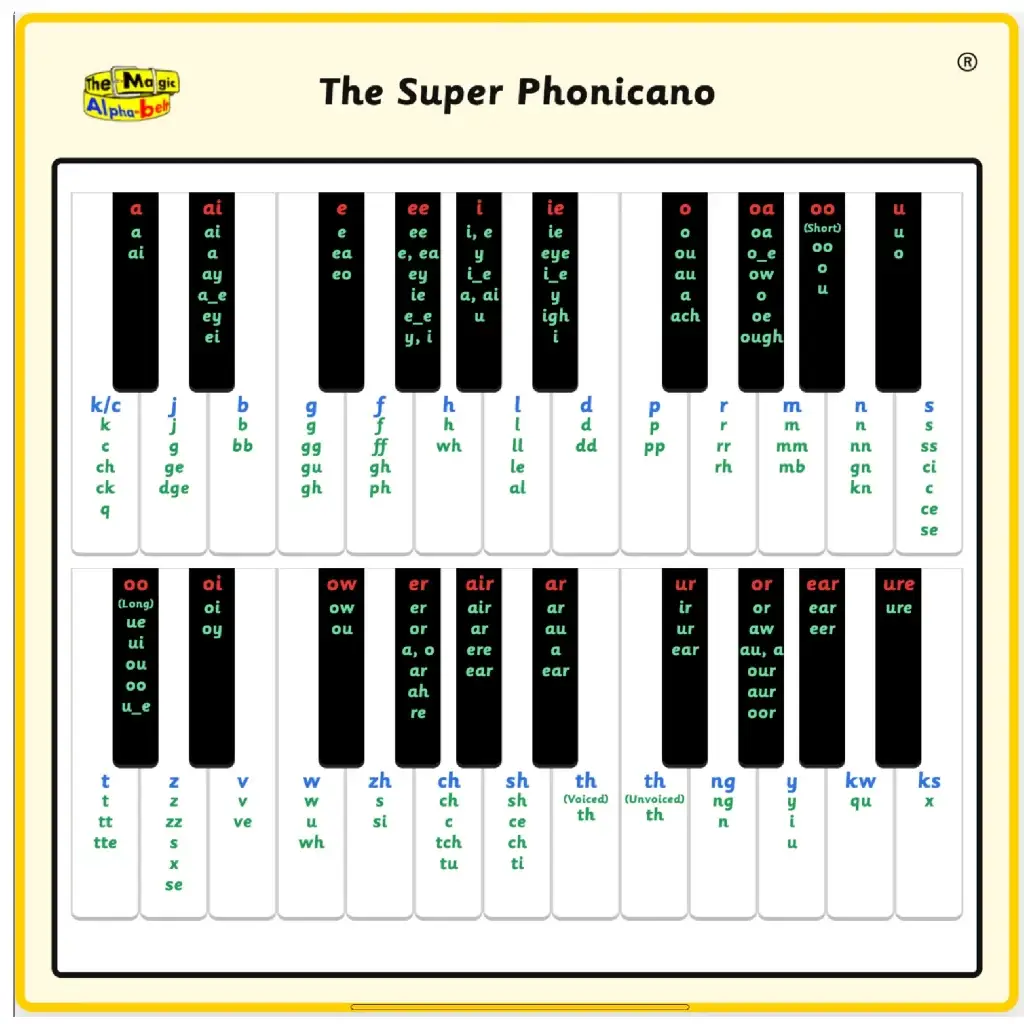
Super Phonicano: Covers 170+ GPCs.
Mega Phonicano: A complete tool covering 240+ GPCs.
.
Does it teach segmenting for spelling and blending for reading?
Yes. Our resources focus on mapping sounds to letters, helping children break words into phonemes for spelling and blend them for reading. The Phonicano, Super Phonicano, and Mega Phonicano include audio buttons for all 44 phonemes. These tools support both visual and auditory learning, enabling children to segment words and write the corresponding letters.
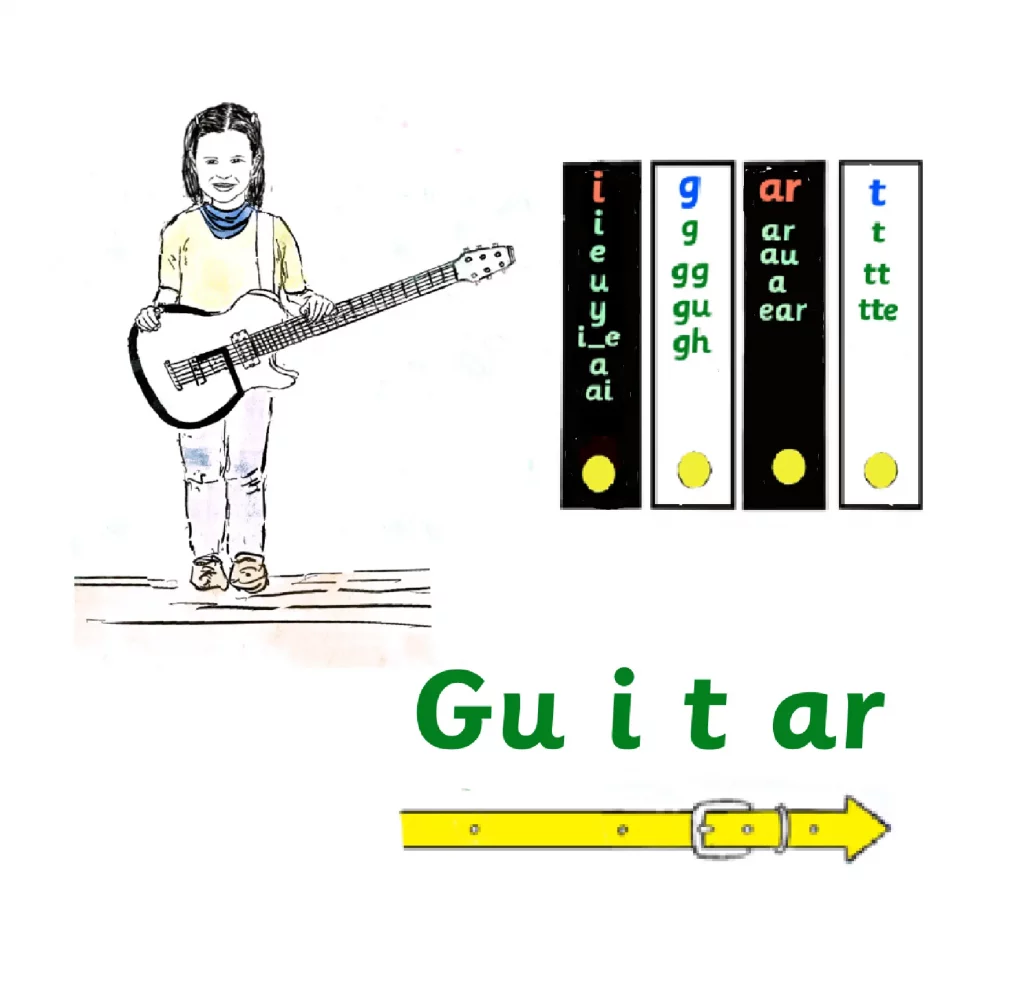
For example, in our activity book Letters, Sounds: Early and Advanced Phonics, children look at a picture of a guitar, arrange the phonemes in order, and select the correct letters to spell the word.
Does it progress cumulatively from simple to complex phonic knowledge and skills, covering major grapheme-phoneme correspondences?
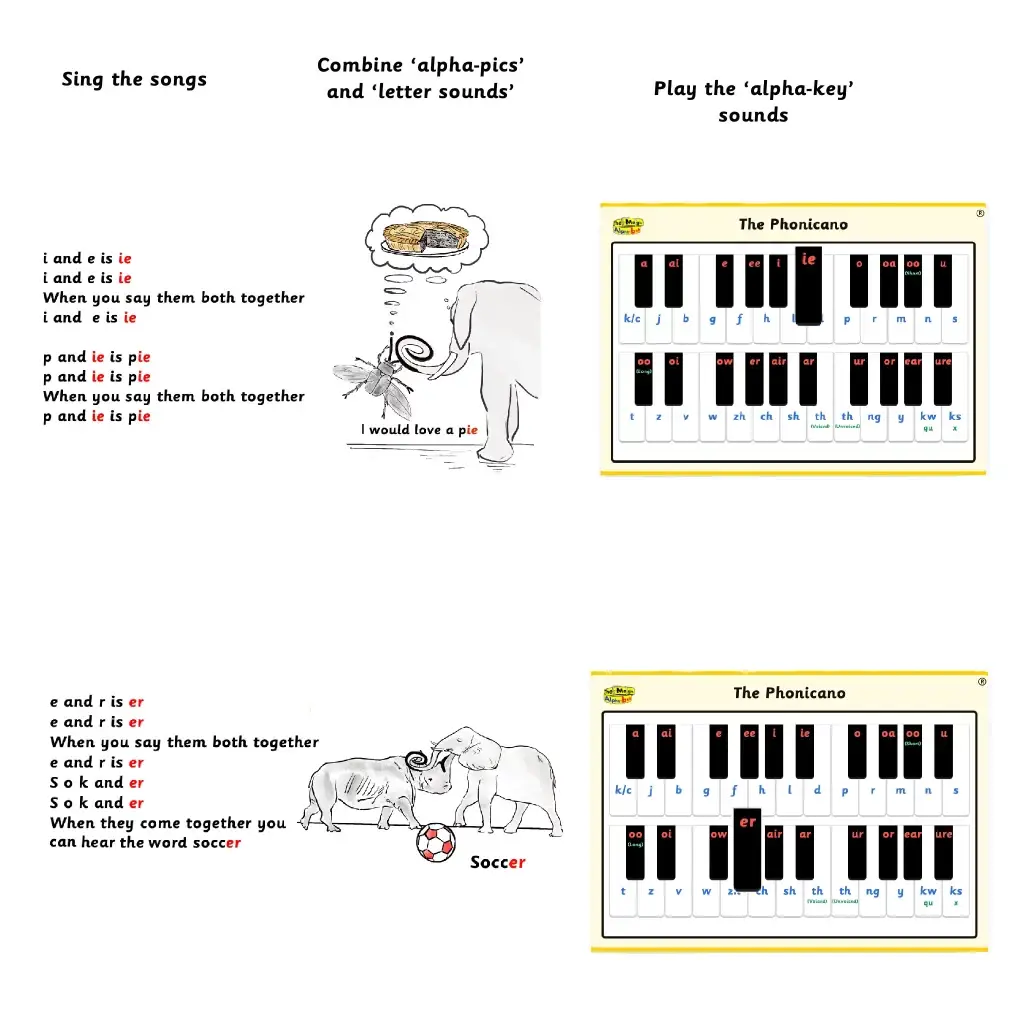
Yes, the Phonicano models follow a structured, progressive approach. They start with basic letter sounds and advance to the 44 phonemes and their alternative spellings. Each stage includes flashcards, instruction booklets, and activity books to reinforce learning. The system is multi-sensory, combining sight, text, and audio. For example, the Mini Phonicano displays a letter, an image linked to the sound, and plays the sound when pressed. Instruction booklets guide children through the Enhancing, Evolving, Expanding, and Empowering stages, helping them build confidence. Learning is consolidated through word-building, exercises, puzzles, and games.
Is it built around direct teaching sessions with extensive teacher-child interaction and a multi-sensory approach?
No, we do not provide materials for direct teaching sessions. This is best delivered by SSP providers in schools. The Magic Alpha-Belt is designed to complement, not replace, existing phonics teaching, offering additional resources for teachers and schools. Our multi-sensory audio Phonicano models allow children to explore sounds, letters, and words interactively, progressing from simple to complex concepts.
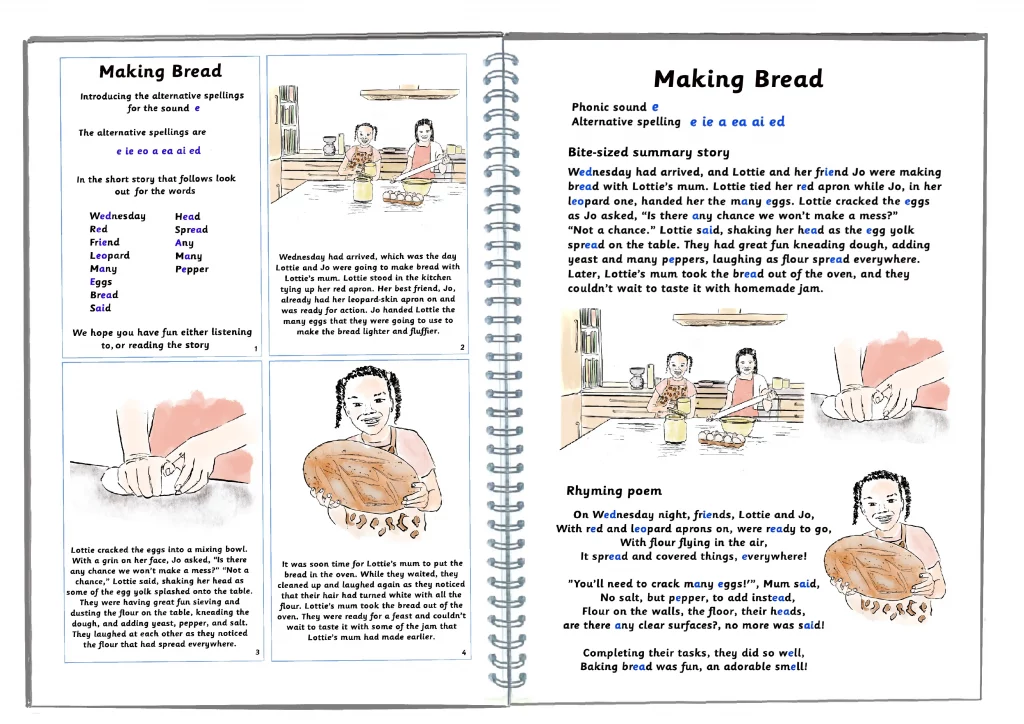
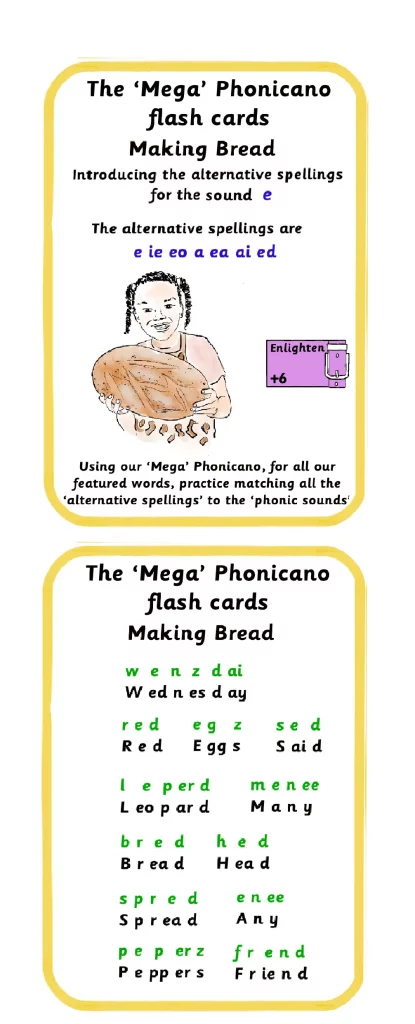
Our final stage—the Enlightening stage—is aimed at children aged 6 and over. It introduces our ‘Phonics Through Stories’ series, available in three formats: picture books, bite-sized stories, and rhyming poems. These provide teachers with unique multi-sensory resources for individual or whole-class learning, supporting the transition from decodable to free-reading books. Many teachers and education professionals recognise a gap at this stage, which we have attempted to bridge.
.
Ensures that children are taught to decode and spell common exception words (sometimes called tricky words)
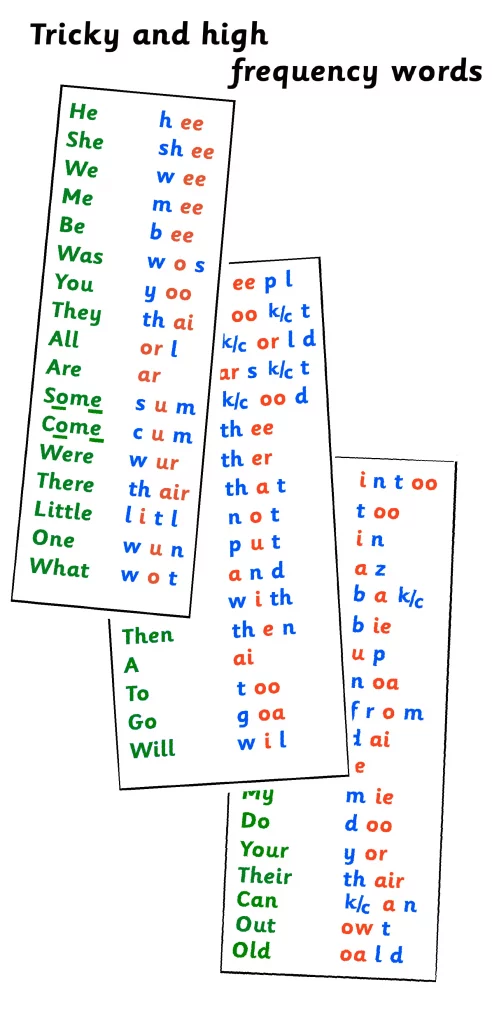
Yes, we introduce a vast number of tricky and high-frequency words that are difficult for children to pronounce because they do not always follow simple phoneme-grapheme correspondence rules. We use the ‘Super Phonicano’ to introduce words where alternative spellings are needed. For example, words like ‘he’, ‘she’, and ‘me’ end with the letter ‘e’ but are pronounced phonetically with the ‘ee’ sound. Practice and repetition of these words help children to sight-read them as part of the decoding and blending process when tackling more complex sentences.
The programme meets the needs of children at risk of falling behind
Yes, at the Magic Alpha-Belt, we’ve designed our resources to help parents and teachers assess children’s progress. Each of the 7E learning stages includes instruction and guidance, followed by activities, tasks, and puzzles. This allows parents and teachers to evaluate whether children have mastered the content and are ready to move on. If children struggle, they can revisit the guidance materials and try the activities again before progressing.
We recommend using Phonicano tools at each stage to provide a multisensory learning experience. These tools support different learning styles, combining visual, auditory, and kinaesthetic methods to help children engage effectively.
Provides guidance for teachers to support effective phonics delivery
The Magic Alpha-Belt is not a validated SSP programme but a supplementary resource designed to support teachers in Reception and Years 1 and 2. It works alongside existing phonics programmes to enhance teaching within the primary curriculum.
We believe the Magic Alpha-Belt enriches direct teaching and strengthens teacher-child interaction by providing a fully multisensory experience. Our resources engage audio, visual, kinaesthetic, and tactile senses, complementing validated phonics programmes to offer variety and choice for different learning styles and teaching methods in both the classroom and home.
For example, our resources help introduce, reinforce, and recall the 44 phonemes. Our Alpha-Phoneme Flashcards create visual and tactile engagement, while our Phonicano Models provide audio and kinaesthetic elements.
We fully support validated phonics programmes that offer excellent instruction. However, introducing variety and choice can enhance the learning experience for teachers, children, and parents throughout the often complex journey of phonics discovery.
Does it introduce a defined set of grapheme-phoneme correspondences?
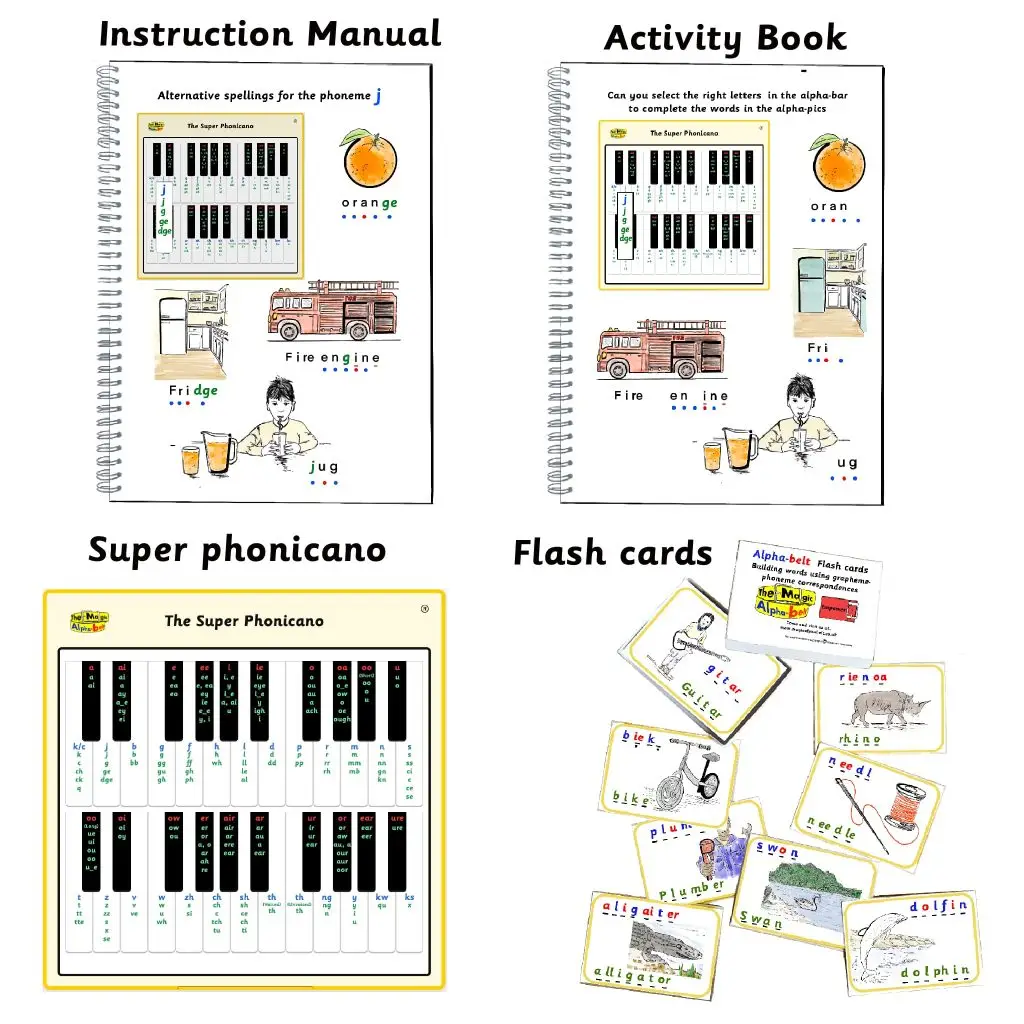
Yes. We begin with simple CVC words and progress to more complex words requiring knowledge of alternative spellings. Our instruction and guidance booklet introduces over 160 grapheme-phoneme correspondences, providing a structured approach. Using the Super Phonicano as a guide, it illustrates the main alternative spellings for each phoneme in English.
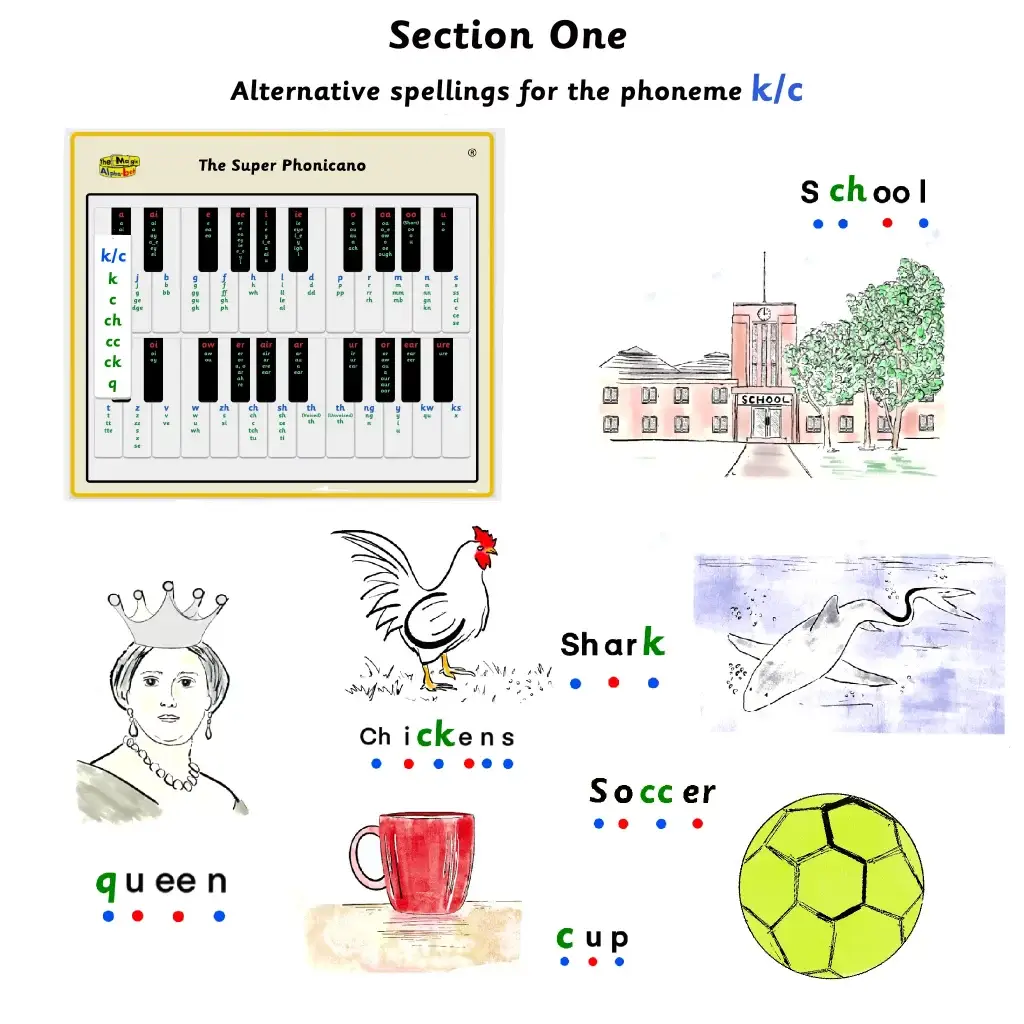
In one of our Instruction and Guidance booklets- Empowering stage for children in reception/year1, we introduce 160 of the alternative spellings in three sections
The alternative spellings for the 44 phonemes See Example page for the phoneme k/c
Split diagraphs
Examples of the same spellings used for different phonemes.
Throughout the booklet we use our full range of alpha-pics to offer a fun element where children are encouraged to find the letters hidden in the alpha-pics
Does it teach the main grapheme-phoneme correspondences of English in a clear, structured sequence?
Yes. Connecting letters to sounds for reading and writing is the alphabetic principle, which underpins all our resources. We introduce and reinforce it progressively, helping children develop phonological awareness, read and write with confidence, and recognise words automatically.
For example, our flashcards support word-building at different levels. They guide children from the 26 single-letter sounds through the 44 phonemes, leading to more advanced stages where these phonemes are represented by different graphemes.
Does it teach children to read printed words by identifying and blending individual phonemes?
Yes, our programme teaches children to read by blending sounds (phonemes) from left to right to form words. Blending means combining individual sounds to make words, while segmenting is breaking words down into their sounds for spelling.
To read a word, children match letters to their sounds and blend them together. To spell, they break the word into sounds and identify the corresponding letters.
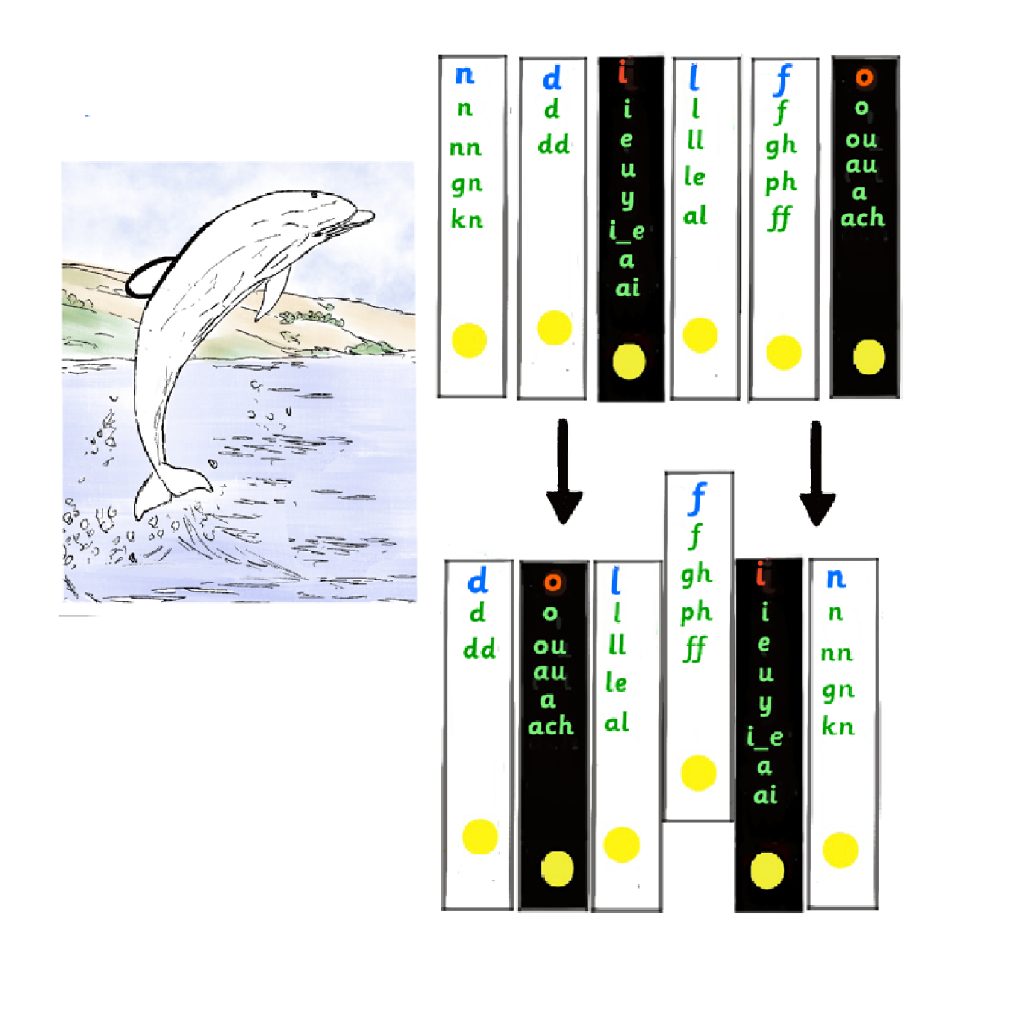
Blending and segmenting are closely linked, and our resources reflect this relationship. For example, in our activity books, children practise blending sounds to form words. One activity involves sounding out the word d-o-l-ph-i-n by clicking the yellow sound buttons on our Phonicano model. Children are tasked with putting the sounds in order and matching them to the correct alternative spellings, as shown on the Alpha-bars that make up the Phonicano.
Provides resources that support teaching lowercase and capital letters correctly, with clear start and finish points
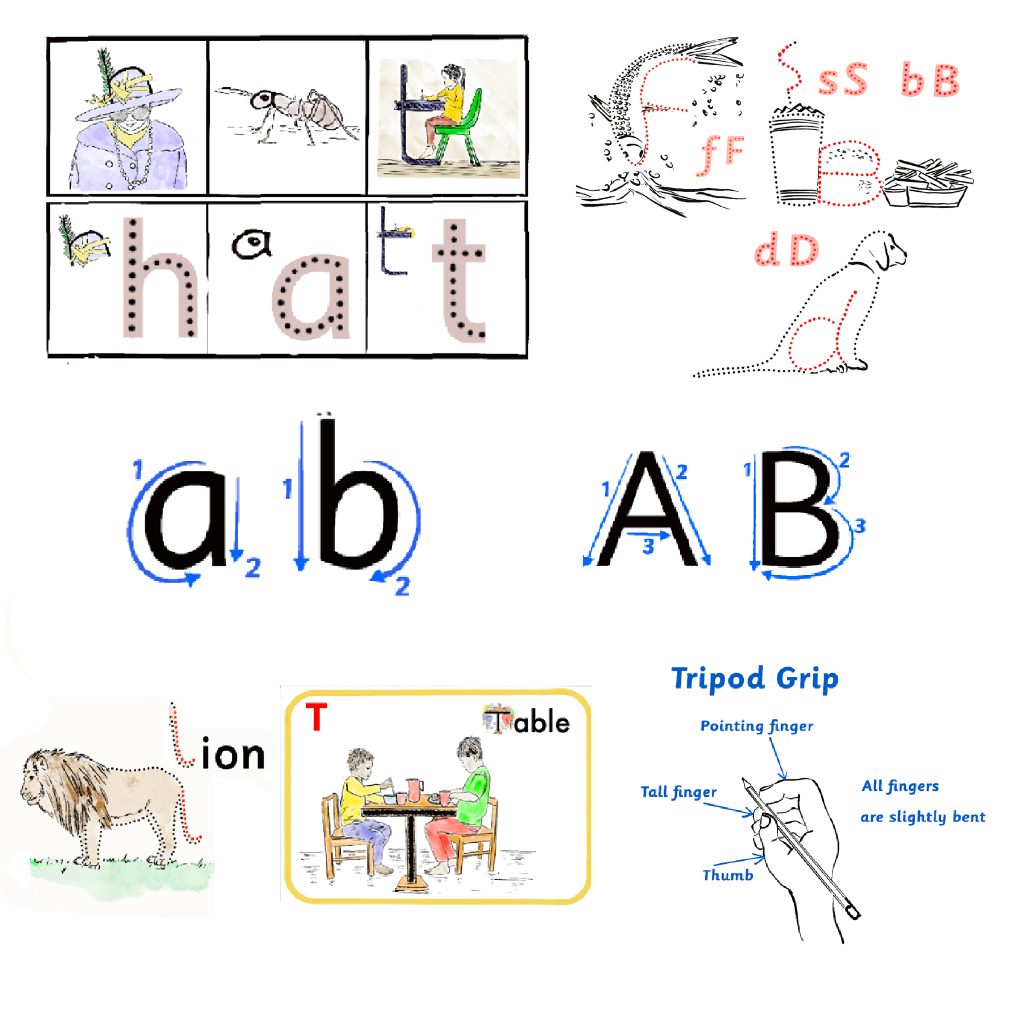
Yes, we introduce children to the shapes and sounds of both lowercase and capital letters at the expanding and engaging stage of learning with the Magic Alpha-Belt, using our alpha-pics to help children recognise, retain, and recall letter sounds. We incorporate our alpha-pics into flashcards to introduce children to both lowercase and capital letters. We have also created a ‘Join the Dots’ activity book, in which children find letters in pictures before joining the dots to complete the letters and the alpha-pics. Our activity book at the enhancing and exploring stage provides opportunities for children to practise writing letters while completing simple CCV and CCVC words. Additionally, we provide clear guidance and instruction on how to write letters, including start and finish points.
Does it include resources to ensure that children practise and apply the core phonics that have been taught?
Yes. Our resources support children in practising and applying core phonics at each stage. These include:
Instruction and Guidance – clear materials to introduce and explain phonics
Activities and Exercises – tasks to practise letter sounds and phonics skills
We also use Alpha-pics, flashcards, posters, adventure storybooks, and our Phonicano tools to reinforce learning. All resources are designed for systematic progression—starting with the 26 single-letter sounds, moving to the 44 phonemes, then over 160 grapheme-phoneme correspondences, and finally more than 240 correspondences.
Our multi-sensory approach—using visual, audio, and hands-on resources—helps build phonemic awareness and confidence in reading and writing.
Does it enable children to start learning phonics early in Reception?
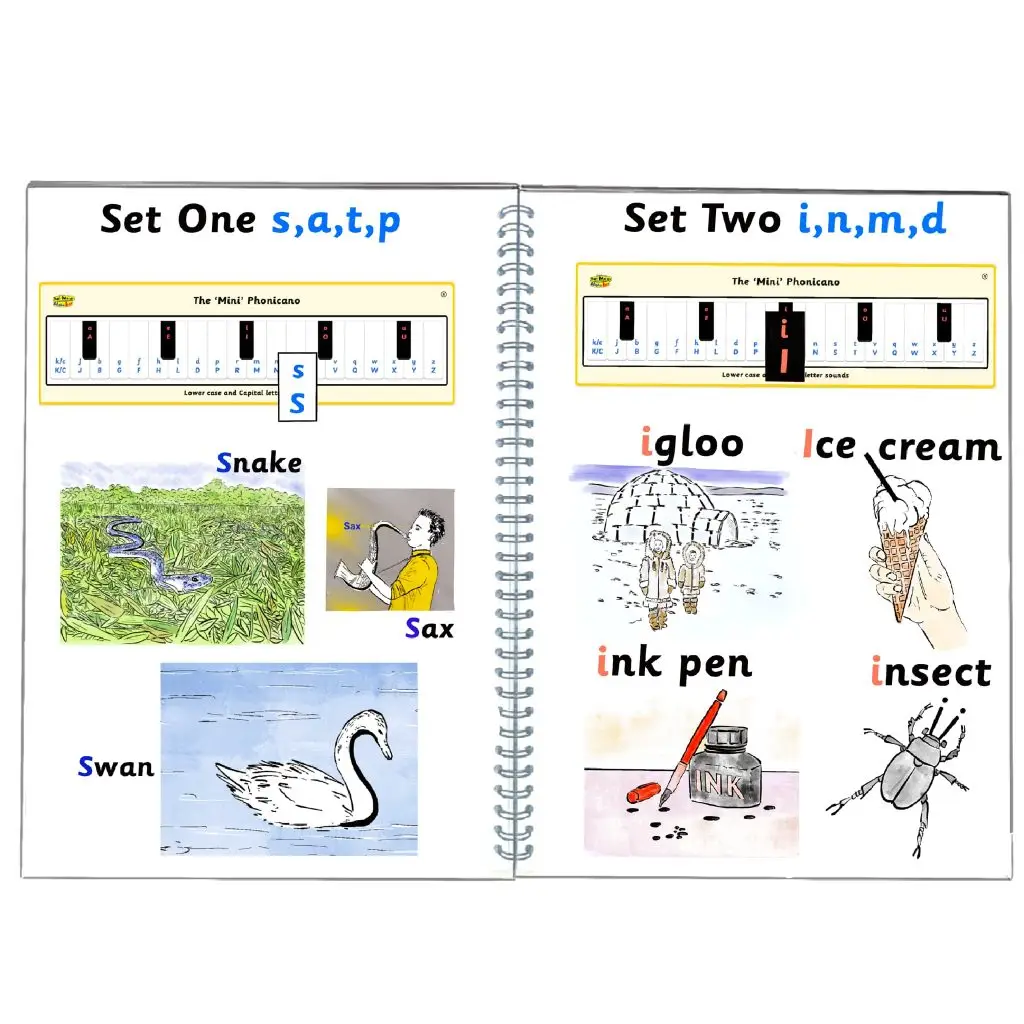
Yes. Our resources support early phonics instruction in line with Reception class teaching. Children begin with the 26 alphabet sounds, taught in sets (e.g., s, a, t, p; then i, n, m, d), progressing to double-letter sounds (e.g., in “egg” and “tree”).
Our activity books include tasks, puzzles and games to reinforce CVC and CCVC words, word families, and rhyming.
As pupils advance, they explore the 44 phonemes, then 170+ GPCs, supporting their work with decodable books, and finally progress to 240+ GPCs—bridging the gap to free readers. This mirrors the DfE’s recommended phonics approach.
Provides opportunities for children to practise and apply known phoneme-grapheme correspondences for spelling
Yes, at the Empowering and Enlightening stages, the Magic Alpha-Belt introduces alternative spellings for the 44 phonemes through fun and engaging alpha-pics. The Empowering stage features our guidance booklet, Introducing Over 160 Grapheme-Phoneme Correspondences, which explains how different graphemes are used in various words. These correspondences align with the ‘decodable books’ stage of phonics teaching in Reception and Year 1.
As children enter Year 2, we provide resources and activities to support their transition from decodable books to free reading. At this stage, we offer over 40 stories in three formats, covering more than 240 grapheme-phoneme correspondences—ensuring children have all they need to become independent readers.
Once children are familiar with different spellings, they can practise applying their knowledge. The Magic Alpha-Belt’s Activity Book and flashcards, such as Building Words Using Grapheme-Phoneme Correspondences, help children blend, segment, decode, and encode words.
Ensures that children progress through the early stages of acquiring phonic knowledge without requiring alternative strategies to read unknown words
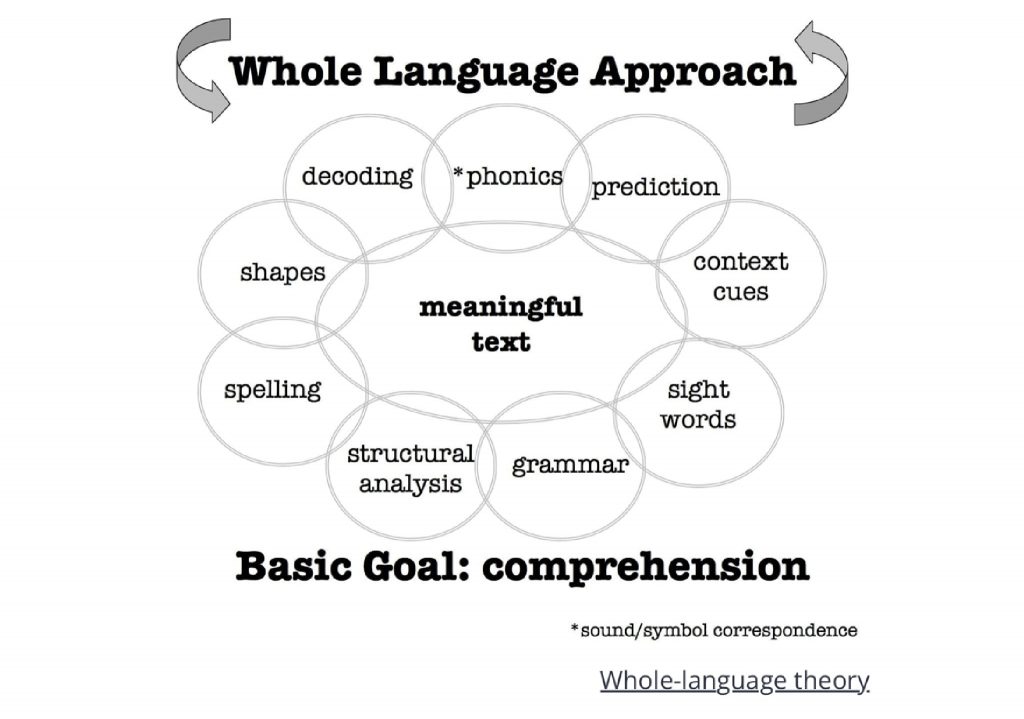
Yes, the stages of learning with the Magic Alpha-Belt focus solely on systematic, synthetic instruction and supporting activities. We recognise that there are alternative approaches to phonics, with some of the most common being whole-word recognition, look-and-say, whole language, and natural reading methods. However, none of these methods are included in our resources and activities.